
Have you ever wondered why we “bite the bullet” or “spill the beans”? Our language is a living museum, filled with fascinating idioms and phrases where the meaning isn’t what you’d expect from the individual words. Many of these expressions are time capsules, carrying stories of ancient battles, strange customs, and pivotal moments from the past.
When you use a historical idiom, you’re not just speaking; you’re connecting with a piece of history! In art and creative writing, these idioms add a layer of depth and authenticity that is truly timeless. This article unearths 40 incredible idioms with roots in history, helping you to understand the amazing stories embedded in our everyday speech.
Why We Use History Idioms in Art and Language
Idioms with historical roots add a layer of wit, wisdom, and shared knowledge to our language. In art and literature, they are a powerful shorthand for complex ideas. Saying a character has “met their Waterloo” instantly connects their personal defeat to one of the most famous battles in history, adding a sense of epic scale. These phrases evoke powerful historical parallels, make dialogue feel more authentic to a certain period, and give our modern expression a timeless, resonant quality that connects with the audience on a deeper level.
Related: Idioms for Healthy
Idioms from History
Here is a tour through time with idioms from Ancient Rome, the battlefields of Europe, and beyond.
Idioms from the Ancient World
1. Cross the Rubicon
- Meaning: To make an irreversible decision or to pass a point of no return.
- Usage Example: “When she submitted her resignation letter, she knew she had crossed the Rubicon.”
- History: This refers to Julius Caesar leading his army across the Rubicon River in 49 BCE, an act of treason that made civil war inevitable.
2. An Achilles’ Heel
- Meaning: A single, fatal weakness despite overall strength.
- Usage Example: “He’s a brilliant strategist, but his pride is his Achilles’ heel.”
- History: In Greek mythology, the warrior Achilles was invincible except for his heel, the one spot where his mother held him when she dipped him in the River Styx.
3. Fiddle While Rome Burns
- Meaning: To do something trivial or irresponsible during a time of crisis.
- Usage Example: “The management is arguing about the color of the new logo while the company is losing money—they’re fiddling while Rome burns.”
- History: This refers to the legend that the Roman Emperor Nero played his lyre (or fiddle) while a great fire destroyed Rome in 64 CE.
4. Beware of Greeks Bearing Gifts
- Meaning: To be suspicious of a gift from an enemy, as it may be a trick.
- Usage Example: “The rival company offered to help us, but I’d beware of Greeks bearing gifts.”
- History: This comes from the story of the Trojan War, where the Greeks left a giant wooden horse as a “gift” for the Trojans, with soldiers hidden inside.
5. The Writing is on the Wall
- Meaning: The signs of a coming disaster or failure are obvious.
- Usage Example: “With sales dropping for the third year in a row, the writing was on the wall for the old company.”
- History: This originates from the biblical Book of Daniel, where a mysterious hand writes a prophecy of doom on the wall during a Babylonian king’s feast.
6. A Pyrrhic Victory
- Meaning: A victory that comes at such a great cost that it is almost a defeat.
- Usage Example: “He won the lawsuit, but his legal fees bankrupted him. It was a Pyrrhic victory.”
- History: This is named after King Pyrrhus of Epirus, who defeated the Romans in 279 BCE but lost so many of his own men that he said, “Another such victory and we are lost.”
7. To Rest on One’s Laurels
- Meaning: To be so satisfied with past successes that you stop trying to achieve new ones.
- Usage Example: “She may have won the championship last year, but she can’t afford to rest on her laurels.”
- History: In ancient Greece and Rome, laurel wreaths were symbols of victory and honor.
Medieval & Military Origins
8. To Bite the Bullet
- Meaning: To endure a difficult or painful situation with courage.
- Usage Example: “He knew the surgery would be painful, but he had to bite the bullet and get it done.”
- History: Before modern anesthesia, surgeons would sometimes have patients bite down on a lead bullet to cope with the pain of an operation.
9. To Bury the Hatchet
- Meaning: To end a conflict and make peace.
- Usage Example: “After years of arguing, the two brothers finally decided to bury the hatchet.”
- History: This comes from a Native American custom where warring tribes would literally bury a hatchet or tomahawk to symbolize a peace agreement.
10. To Be Caught Red-Handed

- Meaning: To be caught in the act of doing something wrong.
- Usage Example: “The thief was caught red-handed with the stolen jewels still in his bag.”
- History: This comes from an old law that stated if someone was caught with the blood of a butchered animal they did not own on their hands, they were guilty.
11. To Throw Down the Gauntlet
- Meaning: To issue a direct challenge to someone.
- Usage Example: “In his speech, the new candidate threw down the gauntlet to the long-serving mayor.”
- History: In medieval times, a knight would throw his armored glove (a gauntlet) at the feet of another knight to challenge him to a duel.
12. To Go Over the Top
- Meaning: To do something in an excessive or ridiculously exaggerated way.
- Usage Example: “A ten-foot-tall birthday cake is just going over the top!”
- History: This phrase originated in World War I, where it literally meant to climb out of the trenches (“go over the top”) to charge at the enemy, an extremely dangerous act.
13. To Steal Someone’s Thunder
- Meaning: To take credit for someone else’s idea or to ruin their big moment by pre-empting it.
- Usage Example: “I was about to announce my engagement, but my sister announced her pregnancy and completely stole my thunder.”
- History: In the 18th century, a playwright named John Dennis invented a machine to make thunder sounds for his play. When his play failed, a rival production of Macbeth used his invention.
14. To Show One’s True Colors
- Meaning: To reveal your real character or intentions.
- Usage Example: “He seemed friendly at first, but when he got angry, he showed his true colors.”
- History: This comes from the age of sailing, where ships would fly flags (“colors”) to identify themselves. A ship might fly false colors to trick an enemy before revealing their true flag at the last moment.
15. To Meet Your Waterloo
- Meaning: To face your final, crushing defeat.
- Usage Example: “The chess champion was undefeated for years, but he finally met his Waterloo against the young prodigy.”
- History: This refers to the Battle of Waterloo in 1815, where Napoleon Bonaparte was decisively and finally defeated.
16. To Buy the Farm
- Meaning: An informal idiom meaning to die.
- Usage Example: “He flew fighter jets his whole life and always joked about never wanting to buy the farm.”
- History: This originated as slang among pilots in World War II. If a pilot’s plane crashed on a farm, the government would often have to pay the farmer for the damages, thus “buying the farm.”
17. To Read the Riot Act
- Meaning: To give someone a stern warning to stop their bad behavior.
- Usage Example: “After the kids broke the window, their father came out and read them the riot act.”
- History: This comes from the Riot Act of 1714 in Britain, a law that had to be read aloud to an unruly mob before they could be legally forced to disperse.
Idioms from Social & Industrial History
18. Mad as a Hatter
- Meaning: To be completely crazy or eccentric.
- Usage Example: “With his strange inventions and wild ideas, the old man was as mad as a hatter.”
- History: In 18th and 19th-century England, hat makers used mercury in the production of felt hats. The prolonged exposure to mercury fumes often caused tremors and dementia, making them appear “mad.”
19. To Let the Cat Out of the Bag
- Meaning: To reveal a secret, usually by accident.
- Usage Example: “It was supposed to be a surprise party, but my little brother let the cat out of the bag.”
- History: One popular theory is that this comes from medieval markets, where a dishonest merchant might try to sell a cat in a bag (a “poke”) instead of a more valuable piglet.
20. To Be Saved by the Bell
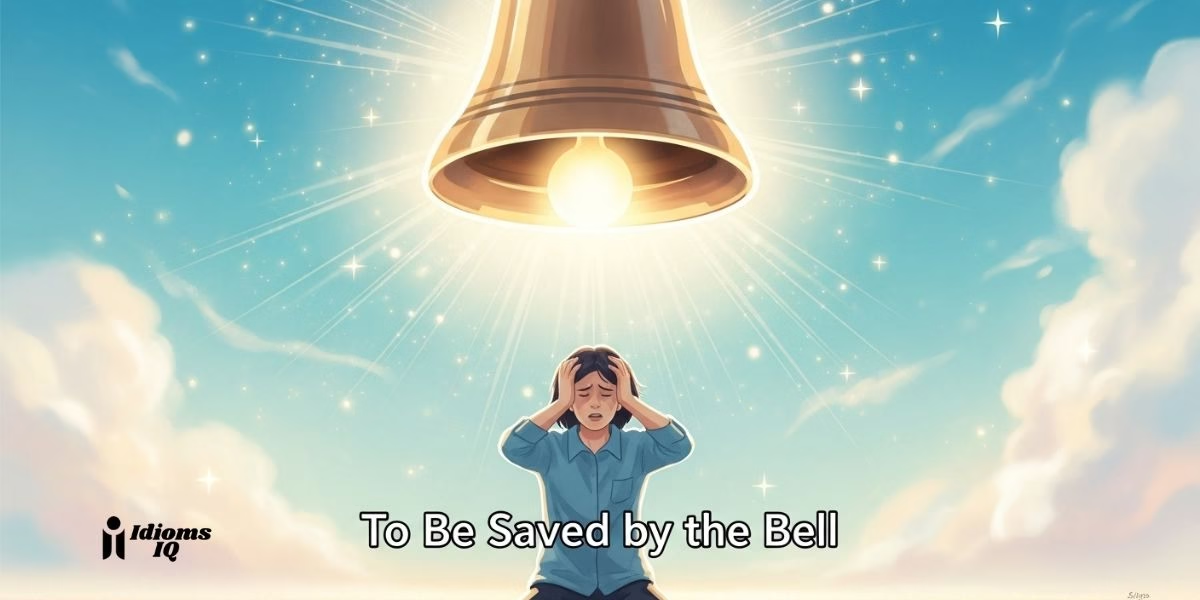
- Meaning: To be rescued from a difficult situation at the very last moment.
- Usage Example: “I was about to answer the teacher’s difficult question when the school bell rang. I was saved by the bell!”
- History: This phrase comes from the world of boxing, where a boxer who is about to be counted out can be saved by the bell signaling the end of the round.
21. To Have an Axe to Grind
- Meaning: To have a hidden agenda or a personal motive for doing something.
- Usage Example: “He’s only supporting the new policy because he has an axe to grind with the person who proposed the old one.”
- History: This idiom is often attributed to Benjamin Franklin, who told a story about a man who tricked him into sharpening his axe for him through flattery.
22. To Spill the Beans
- Meaning: To reveal a secret or tell information that was supposed to be kept private.
- Usage Example: “We were trying to keep the plan a secret, but someone spilled the beans to the press.”
- History: One theory suggests this comes from an ancient Greek voting system where beans were used to cast votes in secret. If the container was spilled, the secret vote would be revealed.
23. To Run Amok
- Meaning: To behave in a wild, uncontrolled, and often violent way.
- Usage Example: “After their team won the championship, the fans ran amok in the streets.”
- History: This phrase was brought to English from the Malay word “amuk,” which described tribal warriors who would work themselves into a frenzied rage before battle.
24. A Blockbuster
- Meaning: A movie, book, or show that is a huge commercial success.
- Usage Example: “The new superhero movie was a summer blockbuster, breaking box office records.”
- History: This term originated in World War II for powerful bombs that were capable of destroying an entire city block.
25. A Pipe Dream
- Meaning: An unrealistic hope or plan that is unlikely to ever happen.
- Usage Example: “His plan to become a famous rockstar without ever practicing is just a pipe dream.”
- History: This idiom is believed to refer to the pleasant but illusory dreams and hallucinations experienced by people smoking opium pipes.
More Idioms from History
36. To Hold the Fort
- Meaning: To take care of a place or situation temporarily while someone in charge is away.
- Usage Example: “I’m going to the post office for an hour; can you hold the fort here until I get back?”
- History: This is a literal military command given to soldiers to defend a fortress or strategic position while awaiting reinforcements or the return of their commander.
37. Not Worth Your Salt
- Meaning: Not deserving of one’s pay or position because you are incompetent or ineffective.
- Usage Example: “If that mechanic can’t even fix a flat tire, he’s not worth his salt.”
- History: This comes from Ancient Rome, where soldiers were sometimes paid a special allowance for salt (salarium argentum), a highly valuable commodity. This Latin term, salarium, is the origin of the modern word “salary.”
38. To Pass the Buck
- Meaning: To shift responsibility or blame for something to another person.
- Usage Example: “It wasn’t my fault, but the manager tried to pass the buck to me.”
- History: This phrase comes from 19th-century poker. A marker, often a knife with a buckhorn handle (a “buck”), was placed in front of the person whose turn it was to deal. If a player didn’t want to deal, they could “pass the buck” to the next player.
39. The Whole Nine Yards
- Meaning: Everything possible or available; the entirety of something.
- Usage Example: “For his wedding, he wanted the best of everything—the suit, the car, the five-course meal, the whole nine yards.”
- History: The origin of this idiom is highly debated, but one popular theory suggests it comes from World War II fighter pilots, whose machine gun ammunition belts were 27 feet (or nine yards) long. To give it “the whole nine yards” was to fire all of your ammunition.
40. To Eat Humble Pie
- Meaning: To admit you are wrong and apologize, especially in a humiliating way.
- Usage Example: “After his prediction was proven completely wrong, the critic had to eat humble pie.”
- History: This comes from medieval England. Following a hunt, the lord of the manor would eat the prime cuts of the deer, while the servants were given a pie made from the entrails and innards, known as “umble pie.” Eating “humble pie” was a sign of one’s low social status.
Practice Your New Vocabulary: Fill in the Blanks
Ready to make history with your language skills? Fill in the blanks with the best idiom from the list.
- He knew he had made a huge mistake and would have to go home and ________________.
- She’s a brilliant designer, but her inability to meet deadlines is her ________________.
- The politician refused to answer the question, but the reporter had an ________________ and wouldn’t let it go.
- After the company’s stocks plummeted, the CEO knew he had ________________.
- I was going to keep it a secret, but my friend accidentally ________________.
- The boss was furious and ________________ to the entire team for being late.
- She had been a world champion for a decade, but she finally ________________ against the younger opponent.
- He was so busy with his new project that he was ________________ every night.
- She knew he was only being nice to her because he wanted to borrow money; she could tell he was trying to ________________.
- The manager is ignoring the obvious problems in the department; she’s ________________.
Answers
- eat humble pie
- Achilles’ heel
- axe to grind
- crossed the Rubicon
- spilled the beans
- read them the riot act
- met her Waterloo
- burning the midnight oil
- curry favor
- fiddling while Rome burns
Conclusion
Idioms with historical roots are like secret pathways into the past, allowing us to carry the drama, wisdom, and humor of bygone eras into our present-day conversations. These phrases are a testament to the fact that language is not just a set of words, but a living, breathing record of human experience.
We encourage you to appreciate these expressions not just as colorful vocabulary, but as a connection to the incredible stories that shaped our world. If you enjoyed this journey through time, continue your exploration by browsing our other articles on the fascinating origins of our language!